Both processes are proven — but proven equipment and a shop that makes money are two different things. What the two look like in real operation, and which shops should not buy.
Burger robots and pancake robots: how mature is single-item fast food automation?
Start with the conclusion: on process, both categories are already proven. Burger robots have been running in overseas chains for nearly a decade, and pancake (jianbing) robots have moved from trade-show samples into stalls that actually trade. But "mature" has to be read on two levels: the equipment being mature and the equipment making money in your shop are two different things. This article sets out the real situation on both sides, so that demo videos do not lead you astray and you do not find out only after delivery that the scenario does not fit.
A single-item robot works on a simple logic: keep one flagship product on the menu, break its production into fixed motions, and hand them to a machine. Burgers and pancakes happen to be the two most standardised sets of motions — unlike Chinese stir-fry they do not depend on a chef's feel, which makes them naturally suited to automation. That is why they matured first, and shredded pork in garlic sauce did not.
Burger robots: the work they do is already standardised
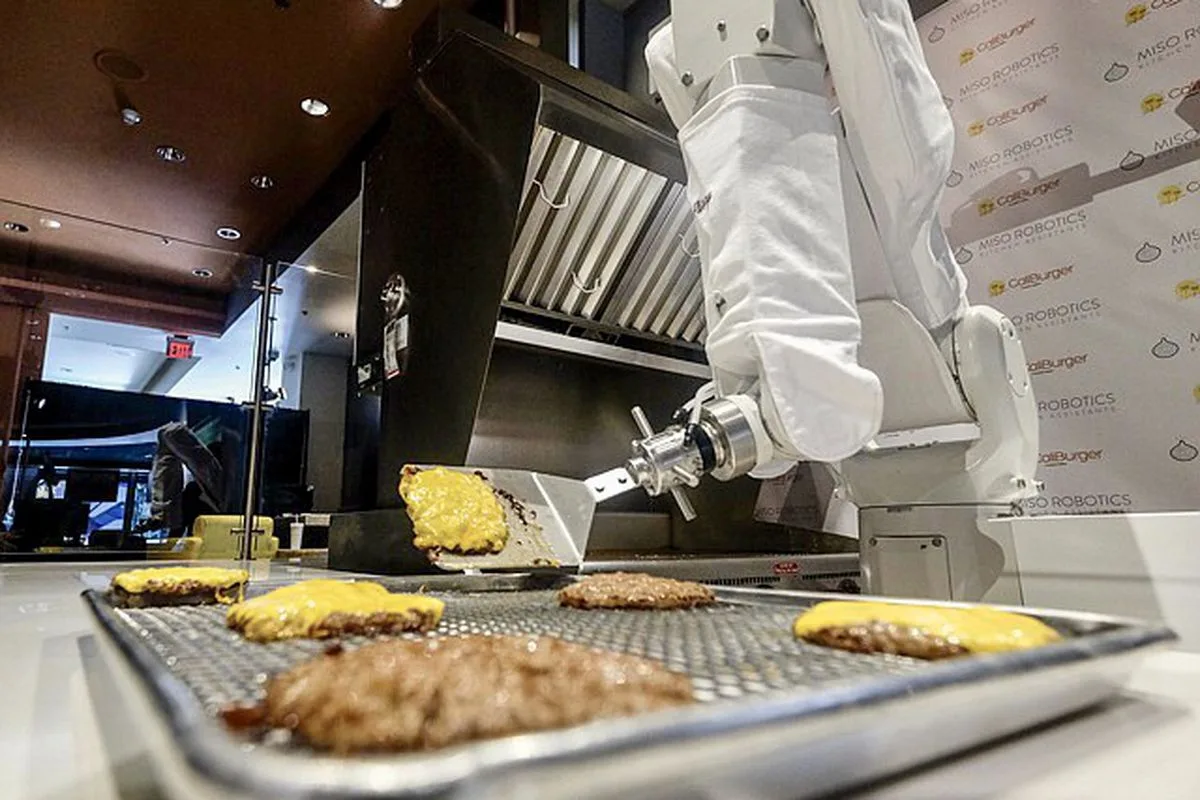
A burger breaks down into a handful of fixed steps: split and toast the bun, griddle the patty, dose the sauce, place the vegetables, close and wrap. Burger robots on the market are essentially modular workstations: a conveyor feeds the buns, a clamshell grill cooks the patties, sauce is metered by pump, and a robotic arm or slide completes assembly. Mainstream single-station models turn out 80 to 150 an hour, dual-station units around 200, with a cycle of 30 to 50 seconds per item. For a peak-time counter serving two or three items a minute, that is enough.
Be clear about one thing, though: a robot makes burgers because the upstream has already done the complicated work — patties are pre-formed, sauces are pre-mixed, buns are a standard size. What really tests the equipment is never the robotic arm but the supply stability and dimensional consistency of these semi-finished parts. Change the sauce batch, or let a patty run two millimetres thick, and the output goes off immediately. Half the effort in a burger robot project therefore lies in supply chain management, not in the machine.
Pancake robots: the hard parts are spreading and heat
A pancake looks more "Chinese" than a burger but the process is actually shorter: dose the batter, spread it round, crack the egg, scatter the toppings, flip, roll. The difficulty is in two places: the batter has to spread evenly, and the heat has to follow the griddle temperature and the queue rhythm. Today's mature pancake robots use a rotating griddle plus an automatic spreading mechanism; a single griddle does 40 to 60 an hour, dual-griddle models 80 to 120, and both batter weight and sauce weight are fully program-controlled. Against a human hand the roundness and thickness are more consistent — that is the robot's advantage.
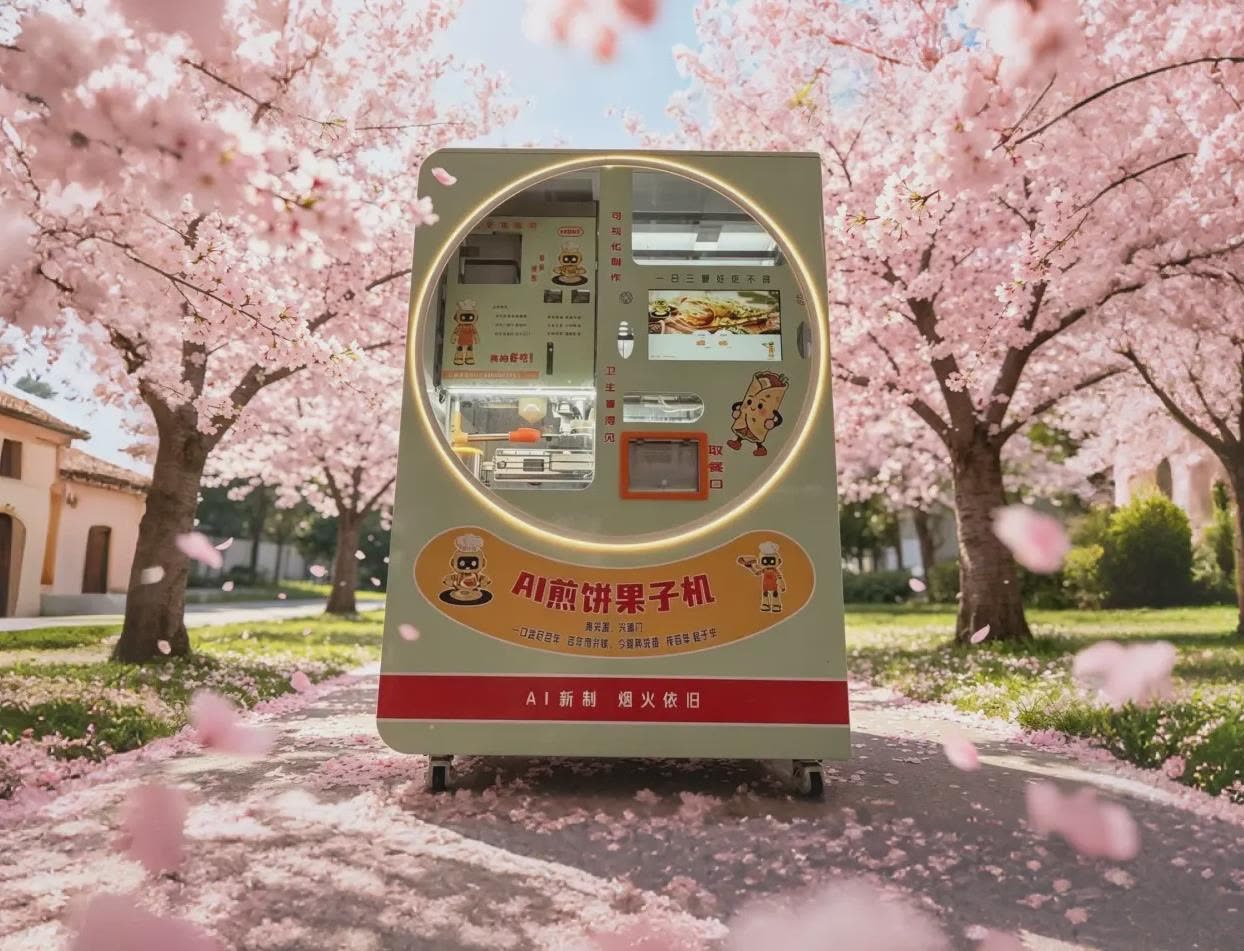
The variable in pancakes is the recipe: batter consistency differs from city to city, and for a high multigrain ratio or a crisper skin the griddle temperature curve has to be adjusted individually. Buying the machine is not plug-in-and-go — the first two weeks go into recipe tuning, and the operator needs to expect that workload. The griddle is also a part in continuous high-temperature contact with food, so how often carbon deposits are cleaned directly determines machine life; when purchasing, include how easy it is to scrape the carbon in your assessment.
How far from plug-in-and-go is it really?
To be honest: the 2025 and 2026 generation has far better failure rates and output consistency than three years ago, but it is still some way from "plug it in and walk away". In real operation staff still do three kinds of work. First, restocking — patties, vegetables, batter and sauce buckets all have to be topped up by hand. Second, handling exceptions — jams, sauce spills and torn skins need human intervention. Third, end-of-day cleaning — every food-contact part is stripped and washed daily, and a pancake griddle needs periodic descaling of carbon. What a machine replaces is the dedicated operator post, not the whole of the labour.
On stall figures we have seen, one pancake robot plus one staff member restocking and packing can cover what two or three people used to do — provided volume keeps it fed. Below 150 pancakes a day a small stall leaves the machine idle most of the time and the depreciation does not come back, so the numbers do not work. The same goes for burgers: below three or four hundred a day, a dual-station unit is a waste.
Which shops suit a single-item robot
- Shops with few SKUs and a high degree of standardisation: the narrower the menu the more the machine pays, and single-product stalls suit it best;
- Scenarios with concentrated peaks: scenic spots, high-speed rail stations, motorway service areas and mall fast-food counters, where a lot of the same item goes out in a short window and the machine neither tires nor takes leave;
- Areas where hiring is hard: single-item production posts have high turnover, and the machine effectively bolts that post to the shop;
- Not suitable: shops built on hand-made freshness, differentiated taste, or a sauce recipe changed every three days — there the robot holds you back.
Four things to verify before ordering
First, take your own shop's recipe and semi-finished parts and run a hundred or more on site, watching the yield rate and consistency — do not trust the twenty perfect samples in a demo. Second, stress it for a continuous hour at your peak rhythm and watch whether the cycle slows and whether it jams. Third, have your staff actually strip and clean it once, with a timer: models that take more than forty minutes to clean will gradually stop being cleaned properly and hygiene will not hold. Fourth, ask precisely about fault response time and local spare parts — when a single-item stall's machine stops, the whole shop stops. The logic of a single-item robot is to make the standardisation solid first and then hand it to the machine; if your product is not standardised, do not buy the machine yet — fix the recipe, the gram weights and the process first.
The content of this article is for selection reference. Specific figures are subject to the manufacturer's official parameters and on-site verification.