A coffee robot point is not a café: location, machine format, revenue per square metre and upkeep decide whether a unit earns 3,000 or 30,000 a month.
Coffee robots as a location business: choosing between malls and office towers, and how to work out revenue per square metre and upkeep
The most common way to run a coffee robot is not to open a café but to take a location: a mall island, an office lobby, a route through a business park — one machine, freshly ground coffee, no staff. The economics of a point are completely different from those of a shop: a shop earns from people plus place, a point earns by spreading fixed cost across a machine. Whether the point is chosen well and the machine spec matched to it decides directly whether a unit takes in three thousand or thirty thousand a month. This article takes the two main point types — mall and office tower — and breaks down the selection, the revenue per square metre and the upkeep calculation.
First separate the two machine formats: the cabinet is fast, the arm is handsome
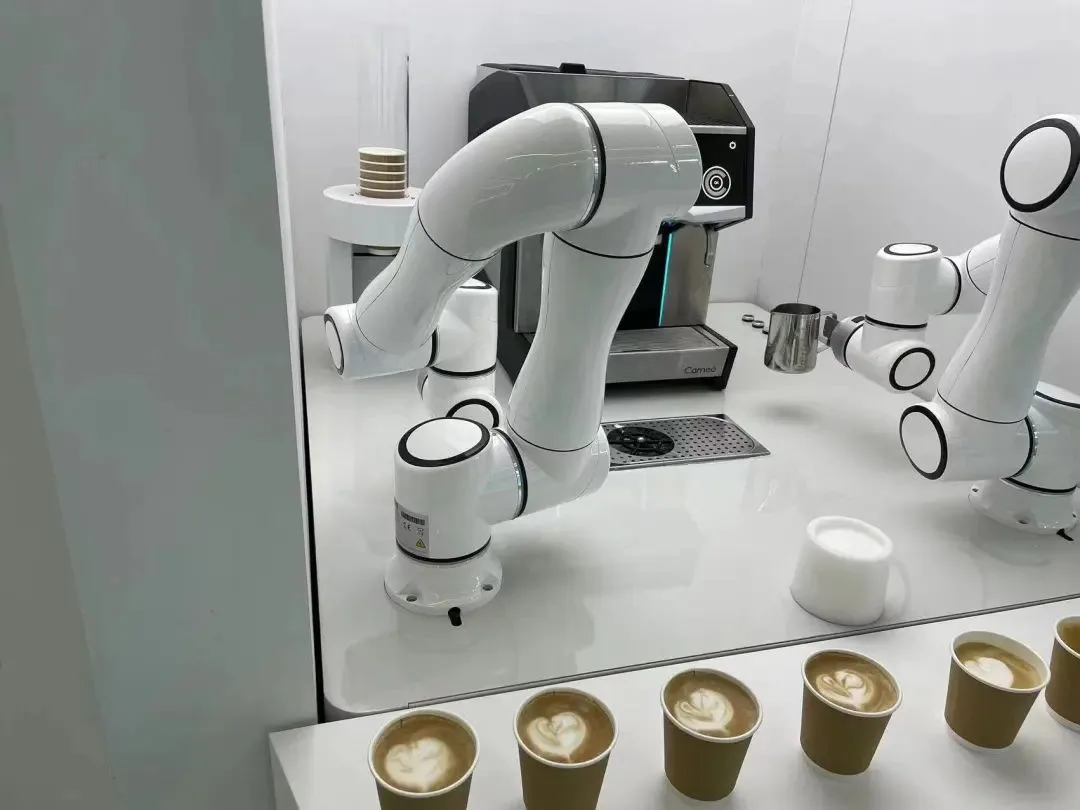
Location coffee robots come mainly in two forms. The integrated cabinet: one to two square metres of floor, with grinding, extraction and milk foaming built in, fast to serve, few faults, simple to maintain, made for volume — the drawback being that output is mostly basic drinks, and latte art is out of the question. The robotic-arm type: one or two collaborative arms imitate a barista, handling cup pickup, extraction, milk texturing and latte art, with strong visual appeal — passers-by stop to watch, photograph and post, which spreads by itself — but it serves more slowly, is more complex, takes up more floor and costs noticeably more. The first decision in selection is volume or visibility: an office tower at morning peak wants speed; a mall island wants looks plus novelty. If you need both, the usual approach is an arm machine as the front of house with a cabinet unit beside it to catch the peak.
A mall point and an office point are two different businesses
The office-tower arithmetic is easy: a fixed clientele with strong repeat purchase, demand concentrated in the morning peak from 7:30 to 10:00 and the afternoon tea window from 15:00 to 17:00, so a day's output lands in a few hours. On a floor with 200 desks, a morning peak can produce 30 to 80 cups, and points selling over a hundred cups a day are not rare; machine choice is set by the peak-hour cup rate: if the morning peak demands more than 60 cups an hour, you have to choose a model with dual-head extraction or fast parallel serving. The mall point is the other way round: footfall is large but conversion is low, weekends and holidays carry the business, and on a weekday off-peak an hour may sell only a few cups. What is genuinely valuable at a mall point is the position — outside the cinema exit, at the metro link, beside the lift on the restaurant floor; these positions cost rent, but weekend impulse buying can lift the monthly volume. Before signing a mall point, it is worth counting footfall on site for three days: counting "people who walk past" is useless; count "people who would stop in a drinks area".
Working out revenue per square metre and payback
The formula for a point is not complicated: monthly revenue divided by floor area. A coffee robot point generally occupies 3 to 6 square metres including queueing and operating space, and arm machines need more. Example: a point in an office lobby costs about 4,000 to 8,000 yuan a month in rent plus electricity; selling 100 cups a day at 16 to 20 yuan a cup gives monthly revenue of around 50,000 yuan. Ingredient cost is roughly 30 per cent per cup; after rent, electricity and consumables, monthly gross profit is a little over 20,000 yuan. Equipment runs from just over 100,000 to 300,000-plus yuan, most points pay back in about a year, and a badly placed one will not return in two. Three items are easy to overlook: first, waste — milk and beans have a shelf life once opened, and a slow point can lose five points of margin to spoilage; second, the labour to restock — no barista is stationed on site, but someone has to top up beans, top up milk and clean every day or every other day, and that half hour to an hour a day has to go into the accounts; third, depreciation and repair — repairing an arm machine is not cheap, so the quotation should include maintenance cover.
Coffee alone cannot fill the day — combination points are the common answer
A coffee-only point has a familiar weakness: low utilisation across the day, queues at the morning peak and nobody in the afternoon. Points that perform well generally combine: the coffee robot carries the morning must-have, a fresh-juice machine beside it catches the afternoon and the customers with children, and a screen adds QR pre-ordering for milk tea and sparkling drinks. The equipment shares power, water and the restocking route, so upkeep cost is spread while the rent is paid only once. One caution: combination points have power requirements — coffee robot plus juicer plus refrigerated cabinet often totals over 5 kW, and water supply and drainage must be considered; before signing, make the property management confirm the point's electrical capacity and plumbing, since older mall properties stall on exactly this.
Upkeep is the lifeline of a point — hold three bottom lines
The point business earns from being unattended, so if upkeep lags, a machine down for a day means paying a day's rent for nothing. Three bottom lines. First, remote monitoring must be complete: every machine must report bean level, milk level, water temperature, fault codes and live sales, with alerts pushed to a phone. Second, restocking and cleaning must have a fixed rhythm: leave the milk path and lines unwashed for two or three days and both output and hygiene suffer — cleaning the milk circuit is the one inspection step on commercial coffee equipment that can least be skipped. Third, the repair response must be written into the contract: points are scattered across the city, and whether the vendor or service provider can be on site within 24 hours matters far more than the machine being twenty thousand yuan cheaper. Run the network like a small unit — the machines are the troops, restocking and inspection the logistics; move a point that will not sell, densify where it runs well — and the point business can roll from one machine into a network.
The content of this article is for selection reference. Specific figures are subject to the manufacturer's official parameters and on-site verification.