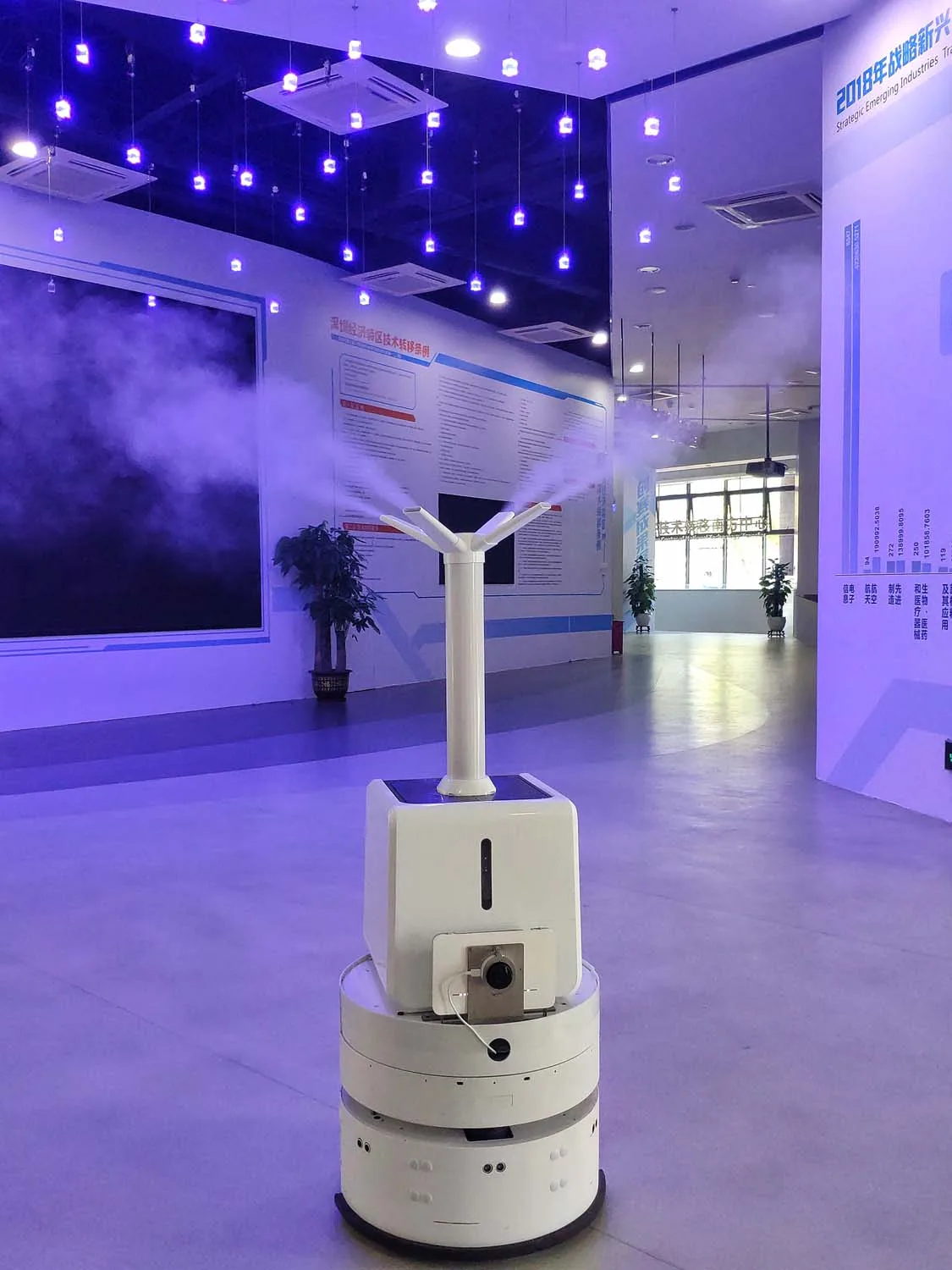
The kitchen has heat sterilisation; the front of house and the private rooms have always been done by hand with a spray bottle — tiring, uneven and easy to miss. Two types of robot, two completely different sets of rules.
How to use a restaurant disinfection robot: UV or spray, the differences and the safety requirements explained in full
The kitchen has heat sterilisation, but the front of house and the private rooms — the air, the tables and chairs, the floor — have always been handled by someone carrying a spray bottle: tiring work, uneven, and easy to miss a spot. In the past few years restaurants have started using disinfection robots, of which there are two mainstream kinds: the ultraviolet disinfection robot and the atomising spray robot. The two work on different principles and the conditions for using them are completely different; choose or use the wrong one and at best you have wasted money, at worst there is a risk to personal safety. This article sets out the differences and the safety requirements in full, and then how to schedule them in a restaurant.
Ultraviolet robots: it is all about dose, and they travel in straight lines
An ultraviolet disinfection robot uses the UV-C band, at a wavelength near 254 nanometres, which directly damages the nucleic acid of bacteria and viruses and leaves micro-organisms unable to reproduce. The mobile models used in restaurants carry several lamps on top and cover halls and private rooms by moving and by aiming the lamps. Effectiveness comes down to dose — irradiance multiplied by exposure time. A dose of around 40 millijoules per square centimetre gives reliable inactivation of common pathogens and viruses, and air and smooth surfaces can be treated at the same time. The advantage of a robot is that it can run unattended after closing, taking 30 to 60 minutes for a circuit, more evenly than manual spraying, and with an operating log you can check.
Ultraviolet's weakness is that it travels in straight lines: the backs of tables and chairs and any gap the lamp cannot see are blind spots, and anything behind an obstruction — inside a crockery cabinet, under linen — is not treated. A UV robot is therefore suited to whole-environment disinfection and not to localised corners. Restaurants should treat it as environmental disinfection equipment, not as a universal steriliser.
Spray robots: it is all about droplet dispersion, and they reach into gaps
A spray robot atomises disinfectant into fine droplets that disperse through the whole space, and disinfection is completed by the droplets settling and making contact. The usual agents are hypochlorous acid and hydrogen peroxide types: hypochlorous acid is managed under the hygiene requirements for chlorine-containing disinfectants (GB/T 36758-2018), and hydrogen peroxide is controlled by concentration and contact time. The advantage of spraying is that it spreads like a gas and covers the backs and gaps that ultraviolet cannot reach; the disadvantage is that it leaves residue and raises humidity, so metal parts, precision electrical equipment and food-contact surfaces need protection, and after spraying you usually have to ventilate or wait for the agent to break down naturally.
When specifying, also look at how well the equipment matches the restaurant. The disinfection area quoted for a UV model is calculated from the number of lamps and the travel route, but a real restaurant has tables and chairs in the way and partitions with corners, so the covered area has to be discounted against the actual layout — have the supplier walk the route on your floor plan, which is far more reliable than the maximum area on a brochure. For a spray model, look at the droplet size and the area covered by one fill: the larger the room and the higher the ceiling, the greater the tank capacity required. Both types need a basically level floor, so in shops with many thresholds and steps, deal with the floor before the machine arrives.
The differences between the two, laid out in one table
- Killing mechanism: ultraviolet damages nucleic acid directly by light — a physical action; spraying oxidises through contact with the agent — a chemical action;
- How it covers: ultraviolet travels in straight lines and leaves shadow blind spots; spraying disperses into gaps, but the droplets need time to settle, so nobody can go straight back in;
- When it can run: ultraviolet must run with nobody present; spraying can in theory use a low-toxicity agent, but in a restaurant it is in practice also scheduled after closing, away from ingredients and tableware;
- Residue and corrosion: ultraviolet leaves none; spraying leaves a trace, so concentration and ventilation time must follow the agent's instructions;
- Running cost: the main cost of ultraviolet is lamps and electricity, with a lamp life of generally 8,000 to 9,000 hours; spraying requires a continuous supply of disinfectant, with a low unit price but a steady consumption.
Safety requirements: not one item on this list can be skipped
Ultraviolet harms human eyes and skin — that is a hard safety line. A restaurant using a UV robot must do several things. First, it may only be scheduled to run when nobody is present: it must not be switched on during service or while cleaners are in the room. Second, the machine must have human-presence sensing interlocked to it, so that it extinguishes its lamps and stops the moment a person approaches. Third, the operating area must carry warning signs, with a notice at the door reading "UV disinfection in progress — do not enter", and where possible a door-lock interlock. Fourth, operators must be trained before they take the post: after a remote start, clear the area first and then confirm that it is running. Check the equipment selection against GB 28235-2020, the hygiene requirements for ultraviolet disinfection devices, looking at the lamp type, the irradiance test report and whether automatic power cut-off is fitted.
For spray robots the safety focus is on agent management: disinfectants must be separated into those usable on food-contact surfaces and those for area disinfection, the concentration must be mixed strictly to the instructions, and the dose must not be raised to chase a better result; the ventilation time after use follows the agent's instructions, generally 15 to 30 minutes. Operators should wear gloves and a mask, and should mix and fill the agent in a ventilated place.
How to schedule it in a restaurant
The practical routine is a fixed "closing disinfection": after the last service, put the tableware and ingredients away sealed, run the UV robot for whole-environment disinfection, and open the windows to air the room for a quarter of an hour before opening the next day. For enclosed small spaces such as private rooms and toilets, use spray once or twice a week to catch the corners. Keep a disinfection log: date, machine number, running time, agent batch — these are the evidence you can produce at a food-safety inspection. Before buying, ask the supplier three things: whether it has human-presence cut-off; test reports for irradiance dose or droplet size; and whether there is local service capability. Disinfection equipment shows no obvious effect in normal times, but on the day of an inspection or an incident there is no way to add a missing function.
The content of this article is for selection reference. Specific figures are subject to the manufacturer's official parameters and on-site verification.